Hot flashes last for years and it can last up to 14 years. Learn why they persist after menopause, what makes them worse, and which treatments actually help.
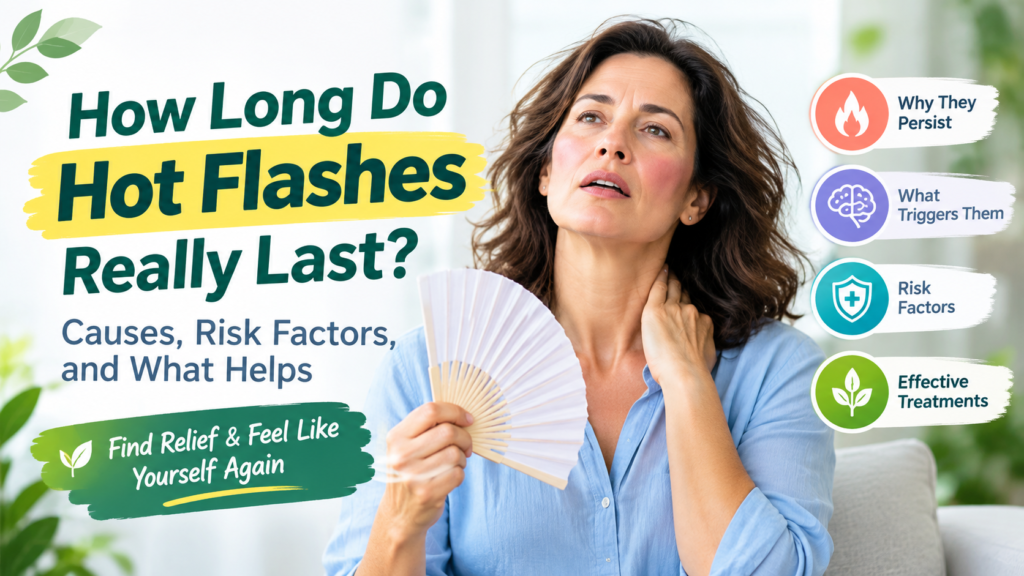
Hot flashes last for years because falling estrogen confuses the brain’s temperature control center. According to a major SWAN study published in JAMA Internal Medicine, the median duration is 7.4 years—and some women experience them for up to 14 or 15 years. When they start, who you are, and your lifestyle all play a role.
You wake up in the middle of the night. You’re sweating. Your heart is racing. Your face feels like it’s on fire. Then, just as fast as it came, it fades.
That’s a hot flash. And for millions of women, it doesn’t happen once. It happens again and again—for years.
Many women expect hot flashes to last a year or two. The reality? They often stick around much longer. So why does this happen? What causes hot flashes to drag on? And what can you actually do about them?
This guide answers all of those questions. It covers the science, the risk factors, the triggers, and the best ways to find relief.
What Are Hot Flashes, Exactly?
A hot flash is a sudden wave of heat in the upper body. It usually hits the face, neck, and chest. It can come with sweating, flushing, chills, and a fast heartbeat.
Each episode typically lasts 1 to 5 minutes. But they can happen many times a day. According to the American College of Obstetricians and Gynecologists (ACOG), about one-third of women experience more than 10 hot flashes per day.
At night, hot flashes are called night sweats. They can wake you up repeatedly. Over time, this leads to poor sleep, fatigue, and mood changes.
Hot flashes are the most common symptom of menopause. According to the University of Utah Health (2025), about 85% of women going through menopause will have them. Up to 80% of middle-aged women in the United States experience hot flashes around the time of menopause, per ACOG.
Read More: Menopause vs. Perimenopause: What’s the Difference?
What Causes Hot Flashes During Menopause?
To understand hot flashes, you need to understand what happens to your brain during menopause.
How does estrogen affect body temperature?
When your ovaries slow down, estrogen levels drop. Your brain uses estrogen to help control many things—including body temperature.
The part of the brain called the hypothalamus acts like a thermostat. It keeps your body at the right temperature. When estrogen falls, this thermostat becomes oversensitive. It thinks your body is too hot, even when it isn’t.
So it reacts. It opens up blood vessels near the skin. It triggers sweating. It tries to cool you down fast. That reaction is what you feel as a hot flash.
What do KISS1 neurons have to do with it?
Recent research has revealed a key player in this process. According to the University of Utah Health (2025), scientists have identified neurons in the brain called KISS1 neurons. These neurons are responsible for signaling the ovaries and testes to work. They also live in the part of the brain that controls temperature.
When estrogen drops, these KISS1 neurons become overactive. They send strong temperature signals. This causes the rapid rise in skin temperature that you feel during a hot flash.
This research also found that both male and female mice experience temperature changes when these neurons are triggered. Men who lose testosterone due to medical treatments can also get hot flashes. This confirms that hot flashes are a brain response to hormone loss—not just a female experience.
What is the NK3 receptor, and why does it matter?
The NK3 receptor pathway is also involved in hot flashes. This is a brain signaling system linked to hormone activity and temperature control. The FDA has approved a medication called fezolinetant (Veozah) that targets this pathway. This shows that the NK3 system plays a real role in triggering hot flash activity in the brain.
How Long Do Hot Flashes Really Last?
This is the big question. And the answer may surprise you.
What does the research say about hot flash duration?
The largest study on hot flash duration is the Study of Women’s Health Across the Nation (SWAN). Researchers followed 1,449 women from 1996 to 2013. The results were published in JAMA Internal Medicine in 2015.
Here’s what they found:
- The median duration of hot flashes was 7.4 years
- Some women had hot flashes for up to 14 years
- Women with severe hot flashes may experience them for more than 15 years, according to the University of Utah Health (2025)
- Only about 15% of women never have hot flashes during menopause at all
This study is the most comprehensive of its kind. It changed how doctors think about menopausal hot flash duration.
Does when hot flashes start affect how long they last?
Yes—and this is one of the most important findings from the SWAN study.
The earlier hot flashes start, the longer they tend to last. Here’s the breakdown:
- Women who got hot flashes while still having regular periods or in early perimenopause had symptoms for a median of 11.8 years
- About 9 of those years occurred after menopause
- Women whose hot flashes didn’t start until after their periods stopped had them for a median of just 3.4 years after menopause
Only 1 in 5 women in the study started getting hot flashes after menopause. One in 8 started while still having regular periods. Two-thirds started during perimenopause.
So if your hot flashes began before your periods stopped, you may be in for a longer ride.
Who Gets Hot Flashes for Longer? Key Risk Factors
Not every woman experiences hot flashes the same way. Some factors make them more likely to last longer—or feel more intense.
Does race or ethnicity affect how long hot flashes last?
Yes. The SWAN study found significant differences between ethnic groups.
Here’s the median duration of hot flashes by race/ethnicity (according to SWAN, 2015):
| Group | Median Duration |
|---|---|
| African-American women | 10.1 years |
| Hispanic women | 8.9 years |
| Non-Hispanic white women | 6.5 years |
| Asian women | ~5 years |
African-American women had hot flashes for twice as long as Asian women. The reasons for these differences are not fully clear. Researchers suggest genetics, diet, and reproductive history may all play a role.
Does weight affect hot flashes?
Yes. The NIH’s National Institute on Aging reports that women who are overweight or obese may experience more frequent and more severe hot flashes. Maintaining a healthy weight may help reduce how often and how intensely hot flashes occur.
Do stress and mental health play a role?
They do. The SWAN study also found that women with longer-lasting hot flashes tended to have:
- Less education
- Greater perceived stress
- More depression and anxiety
Whether stress causes hot flashes to last longer—or whether long-lasting hot flashes cause stress—is still being studied. But the connection is clear. Night sweats interrupt sleep. Poor sleep raises stress. Stress may make the brain more reactive to hormonal changes. It can become a difficult cycle to break.
Does smoking make hot flashes worse?
Yes. The National Institute on Aging (NIH) notes that smoking can worsen menopausal symptoms, including hot flashes. Quitting smoking benefits both hot flash management and overall health.
What Triggers a Hot Flash?
Hot flashes don’t always come out of nowhere. Many women notice patterns. Certain things seem to set them off. Knowing your triggers can help you manage symptoms better.
Common hot flash triggers
- Alcohol – Even one drink can trigger a hot flash
- Spicy foods – They raise body temperature from the inside
- Caffeine – Coffee, tea, and energy drinks can make symptoms worse
- Hot drinks – Any warm beverage can trigger an episode
- Stress – Emotional tension activates the nervous system
- Warm rooms – Environmental heat can tip you over the edge
- Tight or synthetic clothing – Traps heat close to the skin
The NIH’s National Institute on Aging recommends tracking your triggers. Keeping a simple diary can help you spot patterns—and make changes that reduce how often hot flashes strike.
How Hot Flashes Affect Daily Life
Hot flashes aren’t just uncomfortable. They can seriously affect quality of life.
An AARP survey of female members aged 60 to 69 found that 72% said menopausal symptoms interfered with their daily lives. Eight percent said it interfered a great deal.
Even 10 years after menopause began:
- 24% still had hot flashes
- 23% still had night sweats
- 20% still had vaginal dryness
Despite this, 46% of the women in the AARP survey said they had never discussed menopause with a healthcare provider. Only 1 in 12 had been referred to a menopause specialist.
This gap between need and care is real. But there are effective options available. You don’t have to manage hot flashes alone.
How to Manage Hot Flashes: Your Options
There are several proven ways to reduce the frequency and intensity of hot flashes. The right choice depends on your symptoms, health history, and personal preferences.
What lifestyle changes help with hot flashes?
Lifestyle changes are usually the first step. They’re low-risk and can make a real difference.
Cooling strategies:
- Dress in layers you can remove quickly
- Carry a small portable fan
- Keep your bedroom cool at night
- Use light, breathable bedding
Dietary changes:
- Avoid alcohol, caffeine, and spicy foods
- Drink cold water—especially before bed
- Limit hot drinks
Mind-body practices:
- Yoga and meditation have shown early promise in reducing hot flash severity, according to the NIH
- Hypnotherapy may also help manage symptoms
- Mindfulness practices can reduce stress, which may lower hot flash frequency
General health habits:
- Maintain a healthy weight
- Quit smoking
- Get regular physical activity
What non-hormonal medications treat hot flashes?
If lifestyle changes aren’t enough, non-hormonal medications are available.
- Paroxetine (Brisdelle): An FDA-approved antidepressant (SSRI) for hot flash treatment. Users take a lower dose than for depression.
- Fezolinetant (Veozah): An FDA-approved medication that targets the NK3 receptor in the brain. It works directly on the temperature regulation pathway. Liver function monitoring is required during treatment.
- Gabapentin: An anti-seizure medication that has helped some patients, per ACOG.
- Clonidine: A blood pressure medication that may help, especially for women with high blood pressure.
These options suit women who can’t or don’t want to use hormone therapy.
When is hormone therapy the right choice for managing hot flashes?
Hormone therapy (HT) is the most effective treatment for hot flashes. It steadies estrogen levels in the body. It also helps with vaginal dryness, sleep, and bone density.
Hormone therapy comes in several forms: pills, patches, gels, creams, rings, and implants. Patches, gels, and creams carry a lower risk of blood clots than pills.
Women who still have a uterus need to take estrogen with progesterone or progestin. Taking estrogen alone, without a uterus, is also an option.
Known risks of hormone therapy include:
- Blood clots
- Stroke
- Heart attack
- Breast cancer
- Gallbladder disease
- Dementia
The NIH recommends using hormone therapy at the lowest effective dose for the shortest time needed. Always discuss your full medical and family history with your doctor before starting.
Are there natural remedies for hot flashes?
Some women use dietary supplements for relief. Soy products, tofu, and black cohosh are common examples. However, the ACOG notes these are not regulated by the FDA. There is no guarantee of their safety or effectiveness. Always talk to your doctor before trying supplements.
When Should You See a Doctor About Hot Flashes?
You should talk to a healthcare provider if:
- Hot flashes are disrupting your sleep regularly
- Symptoms are affecting your work or relationships
- You’ve tried lifestyle changes with little improvement
- You’re still having hot flashes years after menopause
The University of Utah Health (2025) recommends asking your doctor about their training in menopause care. If current treatments aren’t working, ask for a referral to a menopause specialist. Reproductive endocrinologists, OB-GYNs, and some primary care providers have specialized knowledge in this area.
According to the AARP survey data, far too many women suffer in silence. You deserve care that works.
You Don’t Have to Wait It Out
Hot flashes can last far longer than most people expect. The science is clear: they’re not just a minor inconvenience for a year or two. For many women, they’re a long-term condition driven by real changes in the brain.
The good news is that better awareness leads to better care. Understanding why hot flashes happen—and what keeps them going—puts you in a stronger position to manage them. You have options. Lifestyle changes, non-hormonal medications, and hormone therapy all offer real relief.
Talk to your doctor. Ask questions. Track your symptoms. And know that what you’re experiencing has a name, a cause, and a solution.
Frequently Asked Questions About Hot Flashes
How long do hot flashes typically last for most women?
According to the SWAN study published in JAMA Internal Medicine (2015), the median duration of hot flashes is 7.4 years. Half of the 1,449 women studied experienced symptoms for longer than that. Some women have hot flashes for up to 14 or 15 years.
Why do hot flashes start during perimenopause and not just after menopause?
Hot flashes begin when estrogen levels start dropping—not only after they’ve fully declined. The hypothalamus becomes sensitive to even small hormonal changes during perimenopause. This is why many women notice hot flashes before their periods have fully stopped.
Can hot flashes happen if you’ve already been through menopause for years?
Yes. Research shows that some women continue to have hot flashes well into their 60s and 70s. An AARP survey found that 24% of women aged 60 to 69 still reported active hot flashes, roughly 10 years after menopause.
Do women who get hot flashes early have them longer?
Yes. The SWAN study found that women who started having hot flashes while still menstruating had a median total duration of 11.8 years—nearly three times longer post-menopause than women whose symptoms didn’t start until after their periods stopped.
What is the fastest way to stop a hot flash in the moment?
Cooling strategies offer the most immediate relief. These include stepping into a cool room, drinking cold water, using a portable fan, and removing layers of clothing. Avoiding triggers like alcohol, caffeine, and spicy food can also reduce how often hot flashes occur.
Are hot flashes dangerous to long-term health?
Hot flashes themselves are not dangerous, but they are associated with other health concerns. Studies have linked frequent hot flashes to increased risk of cardiovascular problems and bone loss. Chronic sleep disruption from night sweats can also affect mood, focus, and overall wellbeing. Talk to your doctor if you have concerns.
What is fezolinetant, and how does it help with hot flashes?
Fezolinetant (brand name Veozah) is an FDA-approved non-hormonal medication for moderate to severe hot flashes. It works by blocking the NK3 receptor in the brain—the pathway that triggers the brain’s overheated temperature response during menopause. It requires regular liver function monitoring during use.
Is hormone therapy safe for treating long-term hot flashes?
Hormone therapy is the most effective treatment for hot flashes. It does carry risks, including blood clots, stroke, and breast cancer. The NIH recommends using it at the lowest effective dose for the shortest necessary time. Whether hormone therapy is right for you depends on your personal health history. Discuss this fully with your doctor.